Let 𝐴 be a [[K-monoid|𝕂-monoid]], 𝐵≤𝐴 be a [[Unital subalgebra|𝕂-submonoid]], and 𝑉 be a 𝐵-module.
The 𝐴-module induced by the 𝐵-module 𝑉 is a canonical way of extending 𝑉 to accomodate a representation of 𝐴,
as formalized by the Universal property.1
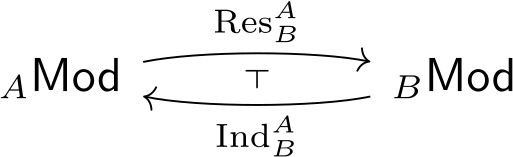
We have the adjunction
Let 𝐴 be [[K-monoid|𝕂-ring]], 𝐵≤𝐴 be a [[Unital subalgebra|𝕂-subring]], and 𝑉 be a 𝐵-module. The 𝐴-module induced by the 𝐵-module 𝑉 is a pair consisting of an 𝐴-module Ind𝐴𝐵𝑉=𝐴⊗𝐵𝑉 and a 𝐵-Module homomorphism𝜄:𝑉→Ind𝐴𝐵𝑉
such that given any 𝐴-module 𝑊 a 𝐵-module homomorphism 𝑓:𝑉→𝑊
factorizes uniquely through 𝜄falg
such that ¯𝑓:Ind𝐴𝐵𝑉→𝑊 is an 𝐴-module homomorphism.
This admits a unique extension to a functorInd𝐴𝐵:𝐵𝖬𝗈𝖽→𝐴𝖬𝗈𝖽 such that 𝜄:1⇒Ind𝐴𝐵:𝐵𝖬𝗈𝖽→𝐵𝖬𝗈𝖽 becomes a natural transformation.
Construction
Let 𝐴⊗𝕂𝑉 be the 𝕂-tensor product with the bilinear map (⊗):𝐴×𝑉→𝐴⊗𝕂𝑉.
Let 𝐾 denote the vector subspace generated by any elements of the form
𝑎𝑏⊗𝑣−𝑎⊗𝑏⋅𝑣
for any 𝑎∈𝐴, 𝑏∈𝐵, and 𝑣∈𝑉.
We construct the induced module as the quotient vector space
𝐴⊗𝐵𝑉=𝐴⊗𝕂𝑉𝐾
with its natural projection 𝜋:𝐴⊗𝕂𝑉↠𝐴⊗𝐵𝑉.
The map
(⊗𝐵)=𝜋∘(⊗𝕂)
defines a representation of 𝐴,
and the inclusion is given by
𝜄:𝑉↪𝐴⊗𝐵𝑉𝑣↦1⊗𝐵𝑣
Proof of the universal property
Let 𝑊 be an 𝐴-module and 𝑓:𝑉→𝑊 be a 𝐵-module homomorphism.
Then for the above diagram to commute, we require that ¯𝑓(𝜄(𝑣))=¯𝑓(1⊗𝐵𝑣)=𝑓(𝑣) for 𝑣∈𝑉.
For ¯𝑓 to be an 𝐴-module homomorphism, it follows ¯𝑓(𝑎⊗𝐵𝑣)=𝑎⋅𝑓(𝑣) for 𝑎∈𝐴 and 𝑣∈𝑉.
Since elements of this form span 𝐴⊗𝐵𝑉, this fully defines ¯𝑓, hence it is unique.