Representation theory of finite symmetric groups
Young operator
Let
and the column antisymmetrizer
then the Young operator is given by sym
Notation
The partition subscripts will typically be written out as a sum for the purpose of these notes, e.g.
. In the literature, it is common to use an entire Young diagram as a subscript. 𝔢 ( 1 2 ) 3 + 2 + 2 = 𝛿 ( 1 2 ) ∗ 𝔢 3 + 2 + 2 ∗ 𝛿 ( 1 2 )
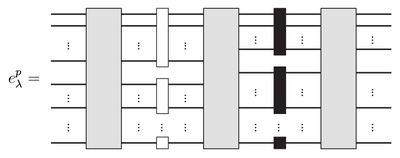
A practical way to do pen-and-paper calculations is with a Birdtrack notation. If single-box symmetrizers and antisymmetrizers are drawn, each line passes through exactly one symmetrizer and exactly one antisymmetrizer. Each (anti)symmetrizer corresponds to a different row (column), with the number of lines passing through given by the number of boxes therein.
Properties
𝐻 𝑝 𝜆 = 𝑝 𝐻 𝜆 𝑝 − 1 𝑉 𝑝 𝜆 = 𝑝 𝑉 𝜆 𝑝 − 1 𝑆 𝑛 𝐻 𝑝 𝜆 ∩ 𝑉 𝑝 𝜆 = { 𝑒 } 𝔢 𝑝 𝜆 = 𝛿 𝑝 ∗ 𝔢 𝜆 ∗ 𝛿 𝑝 − 1 𝔰 𝑝 𝜆 𝔞 𝑝 𝜆 𝐻 𝑝 𝜆 𝑉 𝑝 𝜆 𝔰 𝑝 𝜆 𝔞 𝑝 𝜆 - The young operators
𝔢 𝑝 𝜆 - The irreps generated by
𝔢 𝑝 𝜆 𝔢 𝑞 𝜇 𝜆 = 𝜇 𝑝 𝑞
Proof
The proof is most intuitive with birdtrack arguments.
For
4., we expands the convolution as follows𝔢 𝑝 𝜆 𝔢 𝑝 𝜆 = 𝔞 𝑝 𝜆 𝔰 𝑝 𝜆 𝔞 𝑝 𝜆 𝔰 𝑝 𝜆 = ∑ 𝑞 ∈ 𝑆 𝑛 [ 𝔰 𝑝 𝜆 𝔞 𝑝 𝜆 ] ( 𝑞 ) 𝔞 𝑝 𝜆 𝛿 𝑞 𝔰 𝑝 𝜆 for the term
we get 𝑞 = 𝑒 , and for all other terms either 𝔢 𝑝 𝜆
produces a zero connection (i.e. two lines intersect the same symmetrizer and antisymmetrizer) 𝑞 switches lines connected to the same symmetrizer, giving 𝑞 𝔢 𝑝 𝜆 switches two lines connected to the same antisymmetrizer, giving 𝑞 − 𝔢 𝑝 𝜆 - A combination of
2.and3.gives at most a sign changehence
, but 𝔢 𝑝 𝜆 𝔢 𝑝 𝜆 = 𝜂 𝜆 𝔢 𝑝 𝜆 since 𝜂 𝜆 ≠ 0 and thus 𝔢 𝑝 𝜆 ( 𝑒 ) ≠ 0 . Hence t r P ( 𝔢 𝑝 𝜆 ) ≠ 0 is essentially idempotent. Moreover the above argument already demonstrates the Idempotent primitivity criterion, hence 𝔢 𝑝 𝜆 is primitive. 1 𝜂 𝜆 𝔢 𝑝 𝜆 For
5.we will show that ifthen 𝜆 ≠ 𝜇 for all 𝔢 𝜆 𝑞 𝔢 𝜇 = 0 , i.e. the Equivalence of irreps on left ideals criterion. Consider 𝑞 ∈ ℂ [ 𝐺 ] and 𝔢 𝜆 = 𝔰 𝜆 𝔞 𝜆 in birdtracks, with the symmetrizers and antisymmetrizers ordered from top to bottom from longest to shortest. Then the first symmetrizer of 𝔢 𝜇 = 𝔰 𝜇 𝔢 𝜇 has 𝔰 𝜆 lines, each of which must enter a different one of 𝜆 1 ‘s 𝔞 𝜇 antisymmetrizers if 𝜇 1 , which by the Pigeonhole principle is impossible if 𝔰 𝜆 𝛿 𝑝 𝔞 𝜇 ≠ 0 . If 𝜆 1 > 𝜇 1 , only antisymmetrizers of 𝜆 1 = 𝜇 1 with at least two lines are available, of which there are 𝔞 𝜇 . For a nonzero connection, each of the second symmetrizers 𝜇 2 lines must connect to a different one of these, which is impossible if 𝜆 2 . Continuing this argument we see a nonzero connection of 𝜆 2 > 𝜇 2 to 𝔰 𝜆 is impossible if 𝔞 𝜇 . The same goes for connecting 𝜆 > 𝜇 to 𝔞 𝜆 if 𝔰 𝜇 . Thus by lineärity, if 𝜇 > 𝜆 then 𝜆 ≠ 𝜇 for all 𝔢 𝜆 𝑞 𝔢 𝜇 = 0 . 𝑞 ∈ ℂ [ 𝐺 ] Now since
, it follows that 𝔢 𝑝 𝜆 = 𝛿 𝑝 𝔢 𝜆 𝛿 𝑝 − 1 , hence we have equivalence by the Equivalence of irreps on left ideals criterion. 𝔢 𝑝 𝜆 𝛿 𝑝 𝔢 𝜆 = 𝛿 𝑝 𝔢 𝜆 𝔢 𝜆 = 𝛿 𝑝 𝜂 𝜆 𝔢 𝜆 ≠ 0