Module theory MOC

K-tensor product of modules

Let 𝑀,𝑁 be modules over a commutative ring K. The tensor product 𝑀 βŠ—K𝑁 is an K-module such that the K-bilinear maps from 𝑀 ×𝑁 are in correspondence with the K-linear maps from 𝑀 βŠ—K𝑁, as defined by the Universal property.1 A generalization for the Tensor product of modules over a noncommutative ring exists, but is not necessarily a module. We recover this notion of tensor product as the Tensor product of bimodules.

Universal property

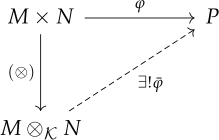
Let 𝑀,𝑁 be K-modules. The tensor product is a pair consisting of an K-module 𝑀 βŠ—K𝑁 together with an K-bilinear map ( βŠ—) :𝑀 ×𝑁 →𝑀 βŠ—K𝑁 such any K-bilinear map πœ‘ :𝑀 ×𝑁 →𝑃 factorizes uniquely through ( βŠ—) comm

A quiver diagram.

such that β€•β€•πœ‘ is K-linear.

Construction

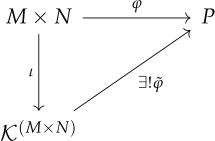
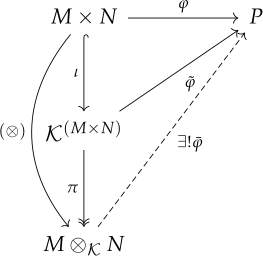
Let 𝑅(𝑀×𝑁) be the free module on 𝑀 ×𝑁 with the natural inclusion function πœ„ :𝑀 ×𝑁 β†ͺ𝑅(𝑀×𝑁). Let 𝐾 denote the K-Submodule of 𝑅(𝑀×𝑁) generated by elements of the form

πœ„(π‘š,𝛼𝑛1+𝛽𝑛2)βˆ’π›Όπœ„(π‘š,𝑛1)βˆ’π›½πœ„(π‘š,𝑛2);πœ„(π›Όπ‘š1+π›½π‘š2,𝑛)βˆ’π›Όπœ„(π‘š1,𝑛)βˆ’π›½πœ„(π‘š2,𝑛);

for all π‘š,π‘š1,π‘š2 βˆˆπ‘€, 𝑛,𝑛1,𝑛2 βˆˆπ‘, 𝛼,𝛽 βˆˆπ‘…. We construct the tensor product as the quotient module

π‘€βŠ—K𝑁=K(𝑀×𝑁)/𝐾

with its natural projection πœ‹ :K(𝑀×𝑁) ↠𝑀 βŠ—K𝑁, so that the map

(βŠ—)=πœ‹βˆ˜πœ„:π‘€Γ—π‘β†’π‘€βŠ—K𝑁

Properties


tidy | en | SemBr

Footnotes

  1. 2009. Algebra: Chapter 0, Β§VIII.2.1, p. 501 ↩